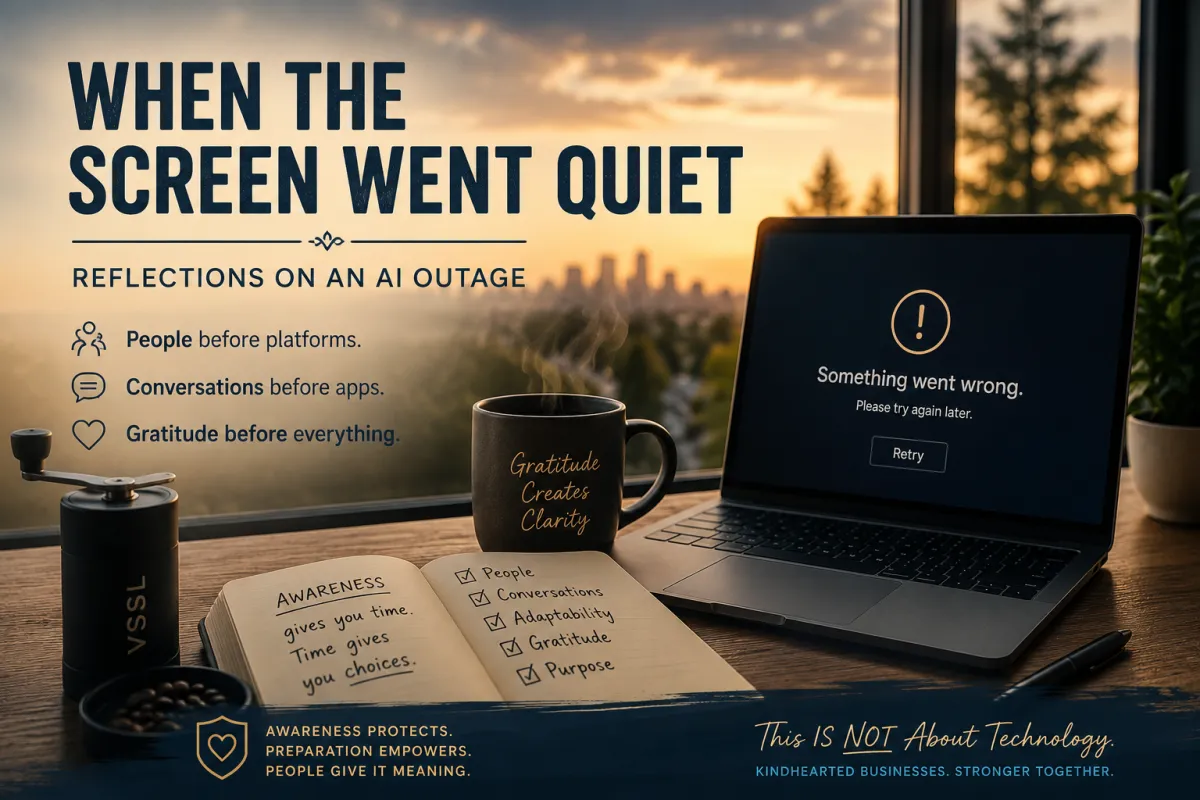
When the Screen Went Quiet | Lessons from an AI Outage
When the Screen Went Quiet
This afternoon something unusual happened.
My screen became quieter than usual. https://status.openai.com/
I smiled.
Not because the service was unavailable, but because it reminded me how quickly we become comfortable with the things that quietly support us every day.
I put the kettle on.
Grinding coffee has a way of slowing my thoughts. The sound of the VSSL grinder, the warmth of the water, and the familiar rhythm of preparing a cup somehow create space that a loading icon never can. As I waited, my thoughts drifted to the millions of people around the world who don't have reliable electricity or access to clean drinking water. Suddenly, this quiet moment with a cup of coffee felt like a gift.
Later I read that the outage had affected developers, businesses, and teams around the world. APIs paused. Projects stopped. Conversations filled with the same question:
"Is it working for you?"
As I sat there, another question quietly arrived.
What happens when something we've come to rely on simply becomes unavailable?
It reminded me of something Hz. Mowlana (Rumi) has been teaching for centuries. When the familiar path disappears, don't rush. Look. Listen. Something else may be trying to introduce itself.
Years ago, businesses worried about losing electricity. Then it was the internet. Today, many of us wonder what happens if AI becomes unavailable for an afternoon.
The tools change.
The question doesn't.
What remains when the thing you've come to depend on becomes quiet?
I don't think resilience begins with another application. I think it begins much earlier—with people, conversations, and the quiet confidence that says, "We'll find another way." The strongest teams I've met don't stay calm because they've anticipated every possible problem. They stay calm because they've learned to trust one another when the unexpected arrives.
As I finished my coffee, another thought came to me.
Perhaps every tool we create is eventually meant to teach us the same lesson.
Don't become attached to the tool.
Become grateful for what the tool allows you to do.
A hammer can build a home, but it never loved the family living inside. AI can help us write, think, and solve problems. It may even help us see possibilities we hadn't considered.
But it will never replace kindness.
Or wisdom.
Or the quiet presence of another human being who simply says, "We'll figure this out together."
By the time my cup was empty, the services were beginning to return.
The screen was busy again.
But I wasn't in a hurry anymore.
Perhaps that quiet hour wasn't an interruption after all.
Perhaps it was a reminder.
To be grateful for the tools that help us.
And even more grateful for the people who give them purpose.
Strong businesses are built on awareness.
Awareness gives you time. Time gives you choices.
Technology helps. People give it meaning.
Awareness protects.